 Vinyl Review
Billy Joel : The Vinyl Collection, Vol. 2 : 2023
Columbia, Legacy, Sony Music
LP, Album, RE, RM + LP, Album, RE, RM + LP, Album,
Near Mint (NM or M-)
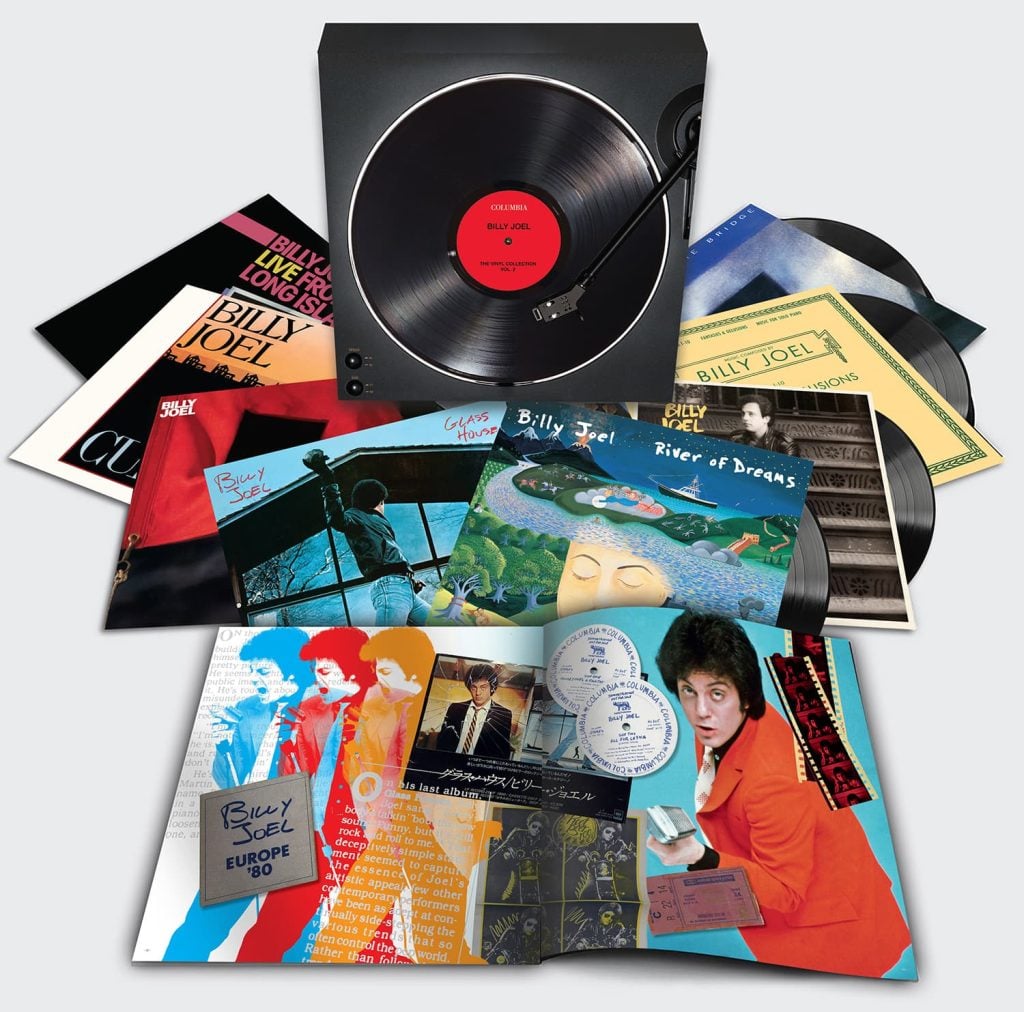
Label: Columbia / Legacy Recordings Format: 11-LP deluxe box set Released: November 3, 2023
Overview
Where The Vinyl Collection, Vol. 1 (2021) chronicled Billy Joel’s scrappy beginnings — six early studio albums plus a previously unreleased 1975 live set — Vol. 2 picks up the story at the exact moment he became inescapable. This box gathers the run of albums that turned Joel from a well-regarded singer-songwriter into a genuine pop institution: Glass Houses, The Nylon Curtain, An Innocent Man, The Bridge, Storm Front, and his final pop studio album, River of Dreams. It rounds things out with two genuine rarities: the first-ever vinyl pressing of Fantasies & Delusions, his 2001 classical piano album, and the first-ever audio release of Live from Long Island, his December 1982 homecoming show at Nassau Coliseum that previously existed only as an HBO broadcast and a VHS tape.
All eight titles were remastered from the original album masters by Ted Jensen, with lacquers cut by Joe Nino-Hernes at Sterling Sound. The set ships with a 60-plus page booklet of Joel’s own annotations and an essay by journalist Rob Tannenbaum. Taken as a whole, it’s less a “collection” than a document of an astonishing decade: a guy who spent the ’70s proving he could write a good song spent the ’80s proving he could write a good song about anything — doo-wop, Cold War dread, Attila the Hun, Long Island commuter trains — and mostly making it look easy.
Below is a disc-by-disc, track-by-track walk through the set.
Disc 1–2: Glass Houses (1980)
The record where Joel stopped apologizing for liking rock and roll. Loud, quick, a little bratty — the whole thing feels like a rebuttal to anyone who’d filed him under “piano man” and left it there.
- You May Be Right — A strutting opener built on Liberty DeVito’s drums, essentially Joel’s mission statement for the whole record: reckless, a little unhinged, thoroughly charming.
- Sometimes a Fantasy — New wave flirtation with a nervy guitar hook; one of his most underrated uptempo cuts.
- Don’t Ask Me Why — Bright, Latin-tinged piano pop that feels like a palate cleanser between the record’s harder edges.
- It’s Still Rock and Roll to Me — The chart-topper, and the thesis of the album delivered as a sneer. It hasn’t aged as a “statement,” but it’s still a great hook.
- All for Leyna — Moody and obsessive, with one of the album’s best vocal performances; a genuine deep-cut favorite among fans.
- I Don’t Want to Be Alone — Tight, economical rocker that doesn’t overstay its welcome.
- Sleeping with the Television On — Understated, a little melancholy; the closest thing on side two to the introspection of his earlier records.
- C’étais Toi (You Were the One) — A sweet, French-flecked ballad that shows off the melodic gift lurking under all the leather-jacket posturing.
- Close to the Borderline — Nervous energy, clattering rhythm, one of the record’s most purely “rock” moments.
- Through the Long Night — A gentle, Beatles-esque closer that quiets the record down after forty minutes of noise.
Disc 3–4: The Nylon Curtain (1982)
Joel’s most ambitious and least commercial-minded record of the era — a conscious attempt at a “serious” album, chasing the production ambition of Sgt. Pepper’s while writing about deindustrialization and Vietnam. It’s the record division of this decade most likely to be called underrated.
- Allentown — A eulogy for the collapse of American manufacturing towns, wrapped in a deceptively hooky melody. One of his best-written songs, full stop.
- Laura — Tense and claustrophobic, detailing a suffocating relationship; the arrangement mirrors the anxiety in the lyric.
- Pressure — Skittering synths and controlled panic; still sounds strange and modern over forty years later.
- Goodnight Saigon — The album’s centerpiece: a Vietnam War narrative built around a slow build of helicopter sound effects and a swelling chorus. Genuinely moving, and a rare case of a pop star successfully handling a subject this heavy.
- She’s Right on Time — A warmer, more conventional pop song that offers some relief after the weight of side one.
- A Room of Our Own — Punchy and a little bitter, with a nagging piano riff.
- Surprises — Brooding and atmospheric, one of the record’s more overlooked tracks.
- Scandinavian Skies — Deliberately Beatles-esque, all backwards tape effects and dreamlike production.
- Where’s the Orchestra? — A quiet, theatrical closer that ends the album on an ambiguous, almost sardonic note.
Disc 5: An Innocent Man (1983)
A hard swerve from Nylon Curtain‘s gravity into pure, joyful pastiche — Joel’s love letter to the doo-wop, soul, and early rock and roll he grew up on. It’s the most purely fun record in this box.
- Easy Money — Brassy and a little over-the-top, a James Brown-indebted horn workout that sets the tone for the homage record to come.
- An Innocent Man — A gorgeous Drifters/Ben E. King-style ballad, and one of Joel’s best vocal takes on any record.
- The Longest Time — Entirely a cappella doo-wop, multi-tracked into a one-man vocal group. A genuine feat and a genuine hit.
- This Night — Builds a modern ballad around a melodic quote from Beethoven’s “Pathétique” sonata — sentimental in the best way.
- Tell Her About It — Motown horns and a sing-along chorus; irresistibly catchy, even if the lyric is a little glib.
- Uptown Girl — The record’s blockbuster single, all Four Seasons falsetto and puppy-dog energy. Practically inescapable in 1983, and still is.
- Careless Talk — A slinkier, more ska-inflected detour; one of the record’s lesser-known tracks.
- Christie Lee — Rockabilly pastiche, fast and a little throwaway, but fun.
- Leave a Tender Moment Alone — A blues-inflected ballad with a memorable harmonica solo.
- Keeping the Faith — A nostalgic closer that essentially narrates the album’s own thesis — a defense of loving old things unironically.
Disc 6: The Bridge (1986)
A transitional, slightly uneven record — Joel dabbling in gated-drum ’80s production and guest spots (Ray Charles, Cyndi Lauper) while trying to figure out what comes after the Innocent Man victory lap. It has fewer stone-cold classics, but some real gems.
- Running on Ice — Jittery and anxious, an odd but engaging opener.
- This Is the Time — A wistful, string-laden ballad about nostalgia for a relationship not yet over; one of the record’s real standouts.
- A Matter of Trust — The one enduring rock anthem here, driven by a chugging guitar riff and one of his most direct vocal performances.
- Modern Woman — Glossy, very of-its-decade synth-pop, originally written for the Ruthless People soundtrack.
- Baby Grand — A duet with Ray Charles, warm and unforced — the two pianos trading lines feels like the whole point of the song.
- Big Man on Mulberry Street — A sprawling, horn-driven, almost theatrical number that plays like a mini movie musical.
- Temptation — Moody and minor-key, one of the record’s darker corners.
- Code of Silence — Co-written with and featuring Cyndi Lauper; an odd, interesting pairing that doesn’t quite fully land but is worth hearing.
- Getting Closer — A tense, near-paranoid closer that ends the record on an unresolved note.
Disc 7–8: Storm Front (1989)
A deliberate reinvention: new producer (Foster to Mick Jones), new band, and a run of songs that put Joel back at the top of the charts after The Bridge‘s comparatively muted reception.
- That’s Not Her Style — A pointed response to tabloid coverage of his marriage; sharper and more personal than the record’s reputation suggests.
- We Didn’t Start the Fire — The famous rapid-fire history lesson. As a piece of songwriting it’s really a list set to a great hook, but the hook is undeniable.
- The Downeaster “Alexa” — A genuinely moving narrative about Long Island fishermen being squeezed out of their livelihood; one of his most underrated story-songs.
- I Go to Extremes — A big, dramatic pop-rock single about emotional volatility, catchy almost to a fault.
- Shameless — Later a bigger hit for Garth Brooks, but the original has a rawer, more direct read.
- Storm Front — A moody, almost cinematic title track that doesn’t get talked about enough.
- Leningrad — A tender, true-story ballad about a friendship formed across the Cold War divide; one of the album’s emotional high points.
- State of Grace — A soaring, string-swept ballad, unfashionable in the best way.
- When in Rome — A tighter, more conventional rock song that keeps the record’s energy up.
- And So It Goes — A stark, solo-piano closer and one of his most purely beautiful ballads — the quiet comedown after the album’s bigger gestures.
Disc 9: River of Dreams (1993)
Joel’s last word as a pop songwriter (he’s released no further original pop material since), and it plays like one — reflective, occasionally bitter, and considerably more spiritual than anything else in the box.
- No Man’s Land — A cynical, anti-suburban-sprawl rocker; one of his angrier songs.
- The Great Wall of China — A pointed kiss-off, widely read as directed at his former manager and one-time brother-in-law.
- Blonde Over Blue — A slow-burning wedding song with a hazy, dreamlike arrangement.
- A Minor Variation — A bruised blues number about depression, more nakedly vulnerable than most of his catalog.
- Shades of Grey — A meditation on moral ambiguity and getting older; understated and thoughtful.
- All About Soul — A soulful duet with Color Me Badd, warmer and less cynical than the record’s opening run.
- Lullabye (Goodnight, My Angel) — A tender song written for his daughter Alexa; one of his most quietly enduring pieces, and it shows.
- The River of Dreams — The gospel-inflected title track and lead single, a genuine surprise hit built on a nagging, chant-like hook.
- Two Thousand Years — A wistful, almost hymn-like song looking toward the next century.
- Famous Last Words — A deliberate, self-aware closer — Joel essentially announcing his own retirement from pop songwriting in real time, which makes it land harder in hindsight.
Disc 10–11: Fantasies & Delusions (2001) — first vinyl pressing
An outlier in every sense: an entirely instrumental album of classical piano compositions written by Joel and performed by pianist Richard Joo, not Joel himself. There’s no “Uptown Girl” energy here — this is Joel indulging the Chopin- and Rachmaninoff-influenced side of his musical education, in pieces like the Suite for Piano (“Star Crossed”), “Fantasy (Film Noir),” and “Waltz No. 1 (Nunley’s Carousel).” It’s a genuine curiosity rather than an essential listen for most casual fans, but its first-ever vinyl pressing here is a real gift to completists, and hearing it on wax rather than CD suits the material’s after-hours, late-night character.
Disc 11 (3LP): Live from Long Island — first-ever audio release
Recorded December 29, 1982, at Nassau Coliseum during the Nylon Curtain tour, this is Joel’s homecoming show — long famous to fans only through the HBO broadcast and a well-worn VHS tape, and finally available here as an audio release for the first time. It’s a full-throttle, hits-heavy set captured at a moment when Joel was arguably at the peak of his live powers, and the energy of a hometown crowd comes through even without the visuals. For anyone who only knows this show as a grainy tape, hearing it cleanly remastered is the single best argument for picking up this whole box.
The Vinyl Itself: Pressing & Sound Quality
Separate from the music, it’s worth reviewing this box on its own terms as a vinyl product, because the pressing quality here is genuinely mixed — a frustrating trait for a deluxe box set at this price point.
Mastering source: All eight titles were remastered by Ted Jensen at Sterling Sound, with lacquers cut by Joe Nino-Hernes, and sourced from “the original album masters” — but that phrase is doing some quiet work, since it means analog masters in some cases and digital transfers in others. That distinction shows up on the actual records.
- Glass Houses, The Nylon Curtain, An Innocent Man: Generally the strongest-sounding pressings in the box — full-bodied, dynamic, and closer to what fans expect from a proper analog cut.
- The Bridge: Solid, unremarkable in a good way — no widely reported issues.
- Storm Front: A weak point. Several listeners and collectors have reported that this title was sourced from a lossy digital file rather than a clean analog or high-resolution digital master, and it shows in a flatter, less detailed presentation than the rest of the set.
- River of Dreams: The most criticized disc in the box — multiple collector reports describe audible distortion on this pressing, which is a particular shame given it’s Joel’s final pop album and arguably deserved the most careful treatment.
- Fantasies & Delusions: As the first-ever vinyl pressing of this title, expectations were high, but a number of copies have been reported with noticeable pops and crackles that persist even after ultrasonic cleaning — suggesting a pressing/manufacturing issue rather than dirty vinyl.
- Live from Long Island: The genuine event of the box, sonically — a previously audio-unreleased concert finally circulating outside of an old VHS transfer. However, some early copies were affected by a manufacturing mix-up in which Side One of this title was mispressed with unrelated hip-hop material instead of the concert audio, an error serious enough that affected buyers should check with the retailer or Sony/Legacy about a replacement.
- General pressing noise: As with other recent Sony/Legacy box sets manufactured at the MPO plant in France, several buyers have reported surface noise — pops, ticks, and general non-silent backgrounds — across multiple titles in the box, beyond just the Fantasies & Delusions issue noted above. Quality reportedly varies from copy to copy, which is typical of MPO pressings in general but is a real risk at this price point.
Presentation: Where the set doesn’t disappoint is the packaging — a sturdy box housing individual album sleeves, plus the 60-plus-page booklet of Joel’s own liner notes and Rob Tannenbaum’s essay, which is a genuinely nice, well-produced piece of collector ephemera regardless of how any individual record sounds.
Bottom line on the vinyl: This is not a uniformly audiophile-grade box. Half of it — Glass Houses, The Nylon Curtain, An Innocent Man, and the once-in-a-lifetime Live from Long Island release (mispressing aside) — sounds terrific and is worth owning on wax. The other half, particularly Storm Front and River of Dreams, feels like it was mastered for expediency rather than for vinyl specifically, and Fantasies & Delusions has enough reported noise-floor issues that a returns policy is worth checking before you buy. If you’re a completist or a devoted fan, it’s still a worthwhile set for the packaging and the two genuine firsts alone — just go in knowing that “deluxe box set” here refers more to scope and presentation than to consistent audiophile mastering.
Final Verdict
As a listening experience, Vol. 2 is a strange, lopsided thing by design — six commercial pop albums of wildly varying styles, bookended by a classical curio and a vintage live document. But that’s really the point: it’s not meant to be heard start to finish so much as owned as a library, album by album, the way Joel’s most devoted fans already think about his catalog. The mastering is a clear step up from most prior CD and streaming versions, and the two vinyl firsts alone — Fantasies & Delusions and Live from Long Island — justify the set for anyone who’s already bought into this era of Joel’s career. Casual fans will find plenty of individual albums here worth owning on their own (Glass Houses and Storm Frontespecially); it’s really the completists who’ll get the most out of owning it as a single, handsome, 11-LP unit.
Highlights across the set: “Allentown,” “Goodnight Saigon,” “An Innocent Man,” “The Longest Time,” “A Matter of Trust,” “The Downeaster ‘Alexa’,” “Leningrad,” “And So It Goes,” “Lullabye (Goodnight, My Angel)”