 Vinyl Review
David Bowie : Aladdin Sane : 1973
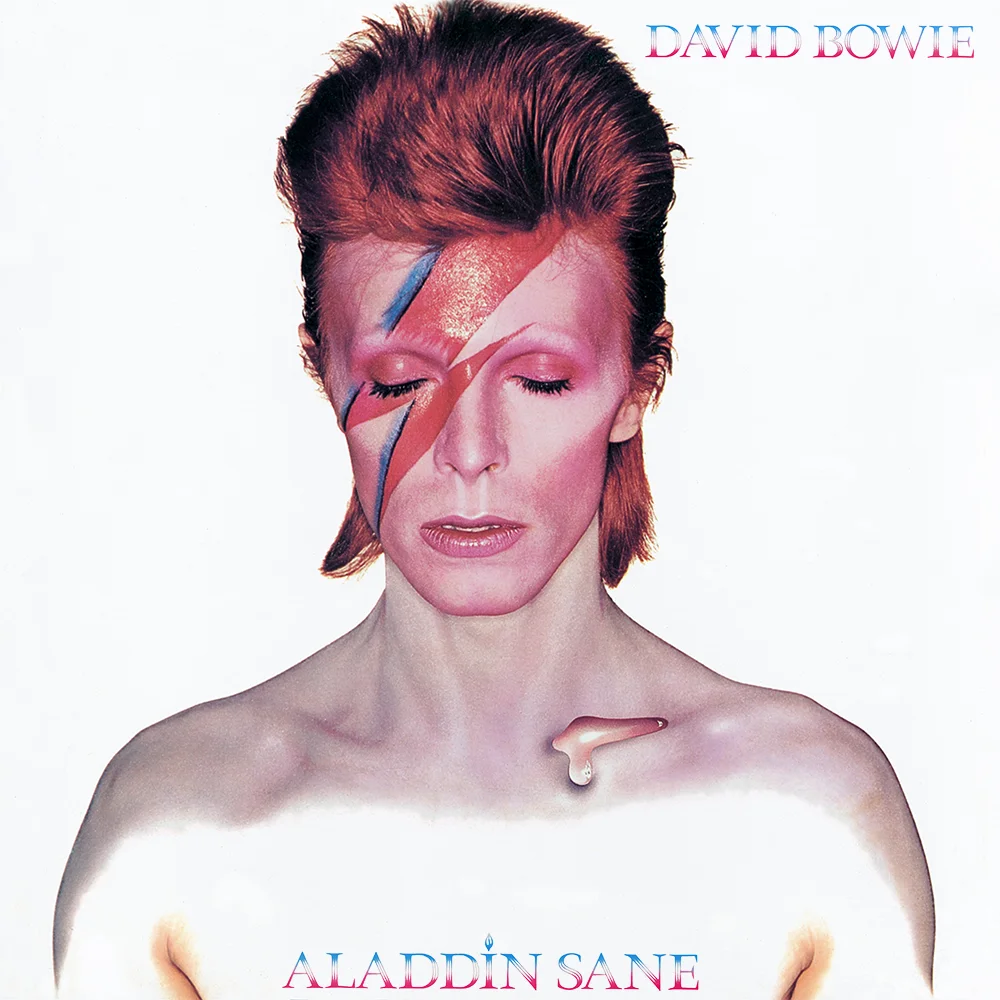
Label: RCA Records Format: LP Released: April 13, 1973 (UK: April 19/20, 1973) Recorded: October 1972, December 1972 – January 1973, Trident Studios (London) and RCA Studios (New York City) Producers: David Bowie, Ken Scott
Overview
Aladdin Sane is the record where David Bowie, having just conquered the world with The Rise and Fall of Ziggy Stardust and the Spiders from Mars, immediately set about complicating that success. Written largely on the road during the American leg of the Ziggy Stardust Tour, it’s often described as “Ziggy Goes to America” — a harder, more cynical, more overtly sexual record than its predecessor, filtered through Bowie’s fascination and unease with the country that had just made him a star. Musically, it’s also a more ambitious record: while the Spiders from Mars lineup (Mick Ronson, Trevor Bolder, Mick Woodmansey) remains largely intact, the addition of pianist Mike Garson — whose avant-garde, free-jazz-inflected playing dominates several key tracks — pushes the album into stranger, more exploratory territory than the glam-rock template Bowie had just perfected.
It would prove to be the last album on which the full Spiders from Mars lineup played together, and it captured Bowie at a genuinely precarious moment — simultaneously the biggest new star in Britain and, as the title itself suggests (a play on “A Lad Insane”), someone keenly aware of how thin the line between stardom and instability could be. Commercially it was an immediate smash, becoming Bowie’s first UK No. 1 album, even as its darker, jazzier, more dissonant moments made clear he had no interest in simply repeating Ziggy Stardust.
Track by Track
Side One
- Watch That Man — A loose, raucous opener often compared to the Rolling Stones’ Exile on Main St., all shambolic energy and a deliberately buried lead vocal beneath the guitars and backing singers.
- Aladdin Sane (1913–1938–197?) — The title track and, by Bowie’s own biographers’ account, the album’s pivotal song: an unsettling, cabaret-inflected piece anchored by Mike Garson’s genuinely avant-garde piano solo, with a title suggesting the years leading up to two world wars and an unwritten, ominous near-future.
- Drive-In Saturday — A gorgeous, doo-wop-influenced glam single imagining a post-apocalyptic future where survivors relearn love and sex from old movies; one of the album’s most purely melodic and beloved tracks.
- Panic in Detroit — Inspired by Iggy Pop’s stories of revolutionaries he’d known in Michigan and the 1967 Detroit riots, this is one of the record’s tensest, most rhythmically driving tracks.
- Cracked Actor — A sleazy, sneering character study of a washed-up Hollywood star, written during Bowie’s time in Los Angeles; raw and cynical in a way that sets the tone for the album’s harder edges.
Side Two
- Time — A dramatic, theatrical meditation on mortality and the passage of time, again dominated by Garson’s piano, and one of the album’s most structurally ambitious pieces.
- The Prettiest Star — A tender re-recording of an earlier Bowie single (originally released in 1970, written for his soon-to-be wife Angela), given a fuller, glam-rock arrangement here with Mick Ronson’s guitar work front and center.
- Let’s Spend the Night Together — A cover of the Rolling Stones classic, sped up and reworked with synthesizers and a harder glam-rock attack, turning the song into something distinctly Bowie’s own.
- The Jean Genie — The album’s biggest hit and most enduring single: a filthy, blues-rock riff wrapped around a character sketch that blends Iggy Pop, glam decadence, and a wink toward French writer Jean Genet.
- Lady Grinning Soul — A late replacement for an earlier planned closing track, this lush, dramatic ballad — inspired by Bowie’s meeting with American soul singer Claudia Lennear — closes the album on its most classically beautiful and romantic note, again built around a spectacular Garson piano performance.
The Vinyl Itself: Pressing & Sound Quality
Aladdin Sane has a genuinely interesting and well-documented original pressing history. The very first UK copies, pressed on heavyweight vinyl with the early smooth, glossy RCA orange labels and the lowest matrix numbers (etched “CPRY 4543-3T” / “CPRY 4544-3T”), are widely regarded by collectors as the best-sounding version of the album — one detailed collector description calls this specific early pressing “most probably the best sounding” of the various Bowie pressings they’ve owned, of which some collectors report tracking down between three and twelve different versions. Shortly after, RCA switched to their “Dynaflex” thin-vinyl process for subsequent pressings (identifiable by a stamped capital “I” in the runouts on US Indianapolis pressings, or noted directly as “Dynaflex” on UK/Canadian copies) — thinner vinyl than the true first pressings, but still frequently praised by owners as sounding excellent in its own right, with at least one longtime collector calling their secondhand Dynaflex copy “exceptional.”
Beyond the vinyl weight and label variations, there are further identifying details worth knowing for anyone chasing an original: the first sleeve printings used a custom seven-color process (including a distinctive silver ink and a true “royal” blue), while later printings switched to standard four-color CMYK printing with a noticeably greenish-cyan blue instead. Modern listeners without access to an original pressing are generally well served by the 2015 180-gram vinyl reissue (part of a wider Bowie remaster campaign), which reviewers have praised for its clarity and dynamics, while noting the album’s dense, layered mixes reward being played at a fairly loud volume to really come alive — a characteristic of the original mix and mastering choices rather than any flaw in the reissue itself.
Final Verdict
Aladdin Sane remains one of the great “difficult second album” success stories in rock history — a record that took the massive commercial template of Ziggy Stardust and pushed it somewhere stranger, harder, and more emotionally ambiguous, without sacrificing any of its predecessor’s melodic power. Mike Garson’s contributions alone (on the title track, “Time,” and “Lady Grinning Soul”) make this one of the most musically adventurous records in Bowie’s catalog, and “The Jean Genie” and “Drive-In Saturday” remain two of his most enduring singles. For vinyl collectors, this is also a genuinely rewarding title to dig into — a strong, well-documented original pressing history means there’s a real, achievable path to hearing this album close to how it was intended to sound, whether via an early heavyweight UK pressing or a well-regarded modern reissue.
Highlights: “The Jean Genie,” “Drive-In Saturday,” “Aladdin Sane (1913–1938–197?),” “Time,” “Lady Grinning Soul,” “Panic in Detroit”