 Vinyl Review
David Bowie : The Rise And Fall Of Ziggy Stardust And The Spiders From Mars : 1972
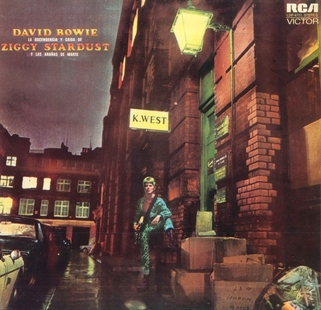
Label: RCA Records Format: LP Released: June 16, 1972 Recorded: July 1971 (“It Ain’t Easy”), November 1971 – February 1972, Trident Studios, London Producers: David Bowie, Ken Scott
Overview
Ziggy Stardust is the album that turned David Bowie from a cult figure with one novelty hit (“Space Oddity”) into one of the defining rock stars of his generation, and it did so through one of the boldest conceptual gambits in rock history: a loose concept album about a doomed, androgynous alien rock messiah, performed by a musician who then adopted that same persona for his own public life. Co-produced with Ken Scott and built around the tight, glammed-up power trio of Mick Ronson, Trevor Bolder, and Mick Woodmansey — the Spiders from Mars — the record fuses the heavier rock sound Bowie had explored on The Man Who Sold the World with genuine pop songcraft, theatrical flair, and an underlying current of apocalyptic dread borrowed as much from A Clockwork Orange as from Marc Bolan’s glam rock.
The “story” of Ziggy Stardust — a rock star who arrives as Earth faces annihilation, only to be destroyed by his own excess and fame — never quite holds together as a literal narrative, and Bowie himself later admitted its plot was thin. But as a mood and an aesthetic, it’s remarkably complete: sleazy, theatrical, doom-laden, and euphoric all at once. A July 1972 performance of “Starman” on Top of the Pops proved the tipping point, catapulting Bowie to stardom almost overnight, and the album has gone on to be widely regarded as not just Bowie’s masterpiece but one of the greatest rock albums ever made.
Track by Track
Side One
- Five Years — A slow-building, devastating opener: the announcement that Earth has five years left to live, delivered with escalating vocal intensity over a simple, marching rhythm that makes the song’s mounting panic feel almost unbearable by its end.
- Soul Love — A warmer, saxophone-inflected track that offers a brief respite from the apocalyptic dread of the opener, musing on different forms of love and devotion.
- Moonage Daydream — A glammed-out, sexually charged glam-rock anthem, and one of Mick Ronson’s finest guitar showcases, building to a genuinely thrilling extended solo.
- Starman — The single that broke the album (and Bowie) wide open: a gorgeous, hopeful anthem about a alien visitor offering salvation, built on one of the most instantly recognizable melodic leaps in Bowie’s catalog.
- It Ain’t Easy — A cover of a Ron Davies song, recorded earlier than the rest of the album; a more straightforward blues-rock number that stands slightly apart in tone from the surrounding material.
Side Two
- Lady Stardust — A tender, piano-led ballad widely read as a tribute to Marc Bolan, capturing the glamour and vulnerability of the emerging glam scene with real warmth.
- Star — A brisk, propulsive statement of ambition, with Ziggy (or Bowie) declaring his intent to become a rock star in blunt, almost gleeful terms.
- Hang On to Yourself — A driving, near-punk rock and roll number that pushes the album’s energy back up after the more reflective “Star,” full of nervy, sexually charged energy.
- Ziggy Stardust — The title track and arguably the album’s signature song: a vivid character sketch of Ziggy’s rise and eventual destruction by his own band, anchored by one of Mick Ronson’s most iconic riffs.
- Suffragette City — A raucous, piano-and-guitar rave-up, all sleazy swagger and one of the most purely fun, high-energy tracks in Bowie’s whole catalog.
- Rock ‘n’ Roll Suicide — The album’s operatic, string-swept closer, building from quiet desperation into a soaring, almost hymn-like declaration of solidarity (“you’re not alone”) that gives the record’s bleak arc a genuinely cathartic, redemptive ending.
The Vinyl Itself: Pressing & Sound Quality
Ziggy Stardust has one of the most heavily debated pressing histories in the entire Bowie catalog, and collectors have spent years comparing notes on which version sounds best. The most consistent advice from serious collectors points toward early UK first pressings — orange-label RCA copies bearing the “Titanic Music” publishing credit, pressed on genuine heavyweight vinyl (not the thinner “Dynaflex” stock RCA switched to shortly after) — as generally the strongest-sounding version, prized for their glossy, high-quality vinyl and superior detail. That said, opinion isn’t unanimous: some longtime collectors and reviewers rate an original 1972 Japanese pressing as equal to or even slightly better than the best UK or US originals, praising its clarity and fullness, while others report that even standard orange-label Dynaflex pressings can sound excellent — one detailed collector account describes a clean, ultrasonically-washed Dynaflex first pressing as “dead quiet” with a “beautiful, clean & full bodied” sound, directly contradicting the assumption that Dynaflex pressings are automatically inferior.
Modern 180-gram reissues are also a live option for anyone not chasing an original: one detailed review found a recent 180g pressing to strike a genuinely satisfying balance between vintage analog warmth and modern pressing clarity, though it’s worth noting that individual copies can occasionally ship with minor issues (that same reviewer reported a brief skip on “Star” that a basic cleaning resolved). Given the sheer number of pressing variants circulating — UK, US, Japanese, and various reissue campaigns across five decades — the general takeaway from the collector community is that there’s no single unimpeachable “best” pressing, but there are several well-regarded, relatively findable options at different price points, from an affordable US first pressing to a more premium original UK or Japanese copy.
Final Verdict
Ziggy Stardust remains a genuine landmark of 20th-century music — an album that fused glam theatricality, apocalyptic dread, and some of the most purely hook-driven songwriting of Bowie’s career into a single, cohesive statement, and one that changed the trajectory of his career (and rock music generally) almost overnight. Every song here has become a classic in its own right, from the desperate opening crawl of “Five Years” to the cathartic release of “Rock ‘n’ Roll Suicide,” and Mick Ronson’s guitar work throughout is as essential to the record’s identity as Bowie’s songwriting and persona. For vinyl collectors, this is a title worth taking some time with — there’s no single perfect pressing to chase, but a wide range of well-regarded originals and reissues means there’s a satisfying way into this album at nearly any budget.
Highlights: “Five Years,” “Starman,” “Ziggy Stardust,” “Suffragette City,” “Moonage Daydream,” “Rock ‘n’ Roll Suicide”