 Vinyl Review
Eagles : Hotel California : 1976
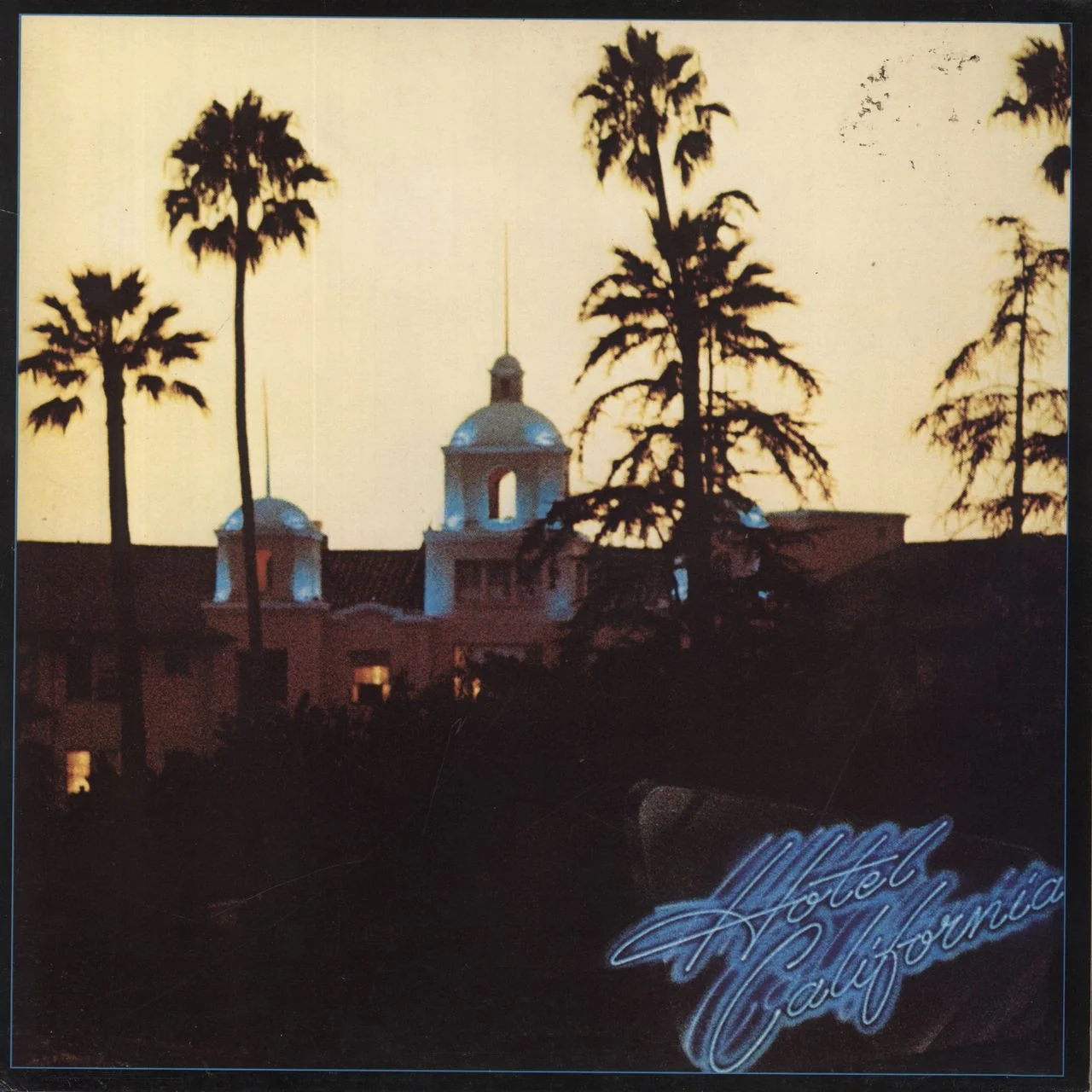
Label: Asylum Records Format: LP Released: December 8, 1976 Recorded: March–October 1976, Criteria Studios (Miami) and Record Plant (Los Angeles) Producer: Bill Szymczyk
Overview
Hotel California is the album where the Eagles shed the last traces of their country-rock origins and stepped fully into arena-rock grandeur. It’s the band’s first record with guitarist Joe Walsh, brought in to replace founding member Bernie Leadon, and his harder-edged rock sensibility (honed in the James Gang and his own solo work) pushes the band’s sound into noticeably more electric, guitar-driven territory than anything on their earlier records. It’s also the last Eagles album to feature founding bassist Randy Meisner, whose falsetto turn on “Try and Love Again” would be his final lead vocal with the band.
Don Henley described the record at the time as a loose concept album — not a literal narrative, but a meditation on America at its bicentennial, tracing “a journey from innocence to experience” and the excesses and disillusionment lurking beneath the promise of the American dream. That theme runs through the album’s two most towering tracks, the title song and “The Last Resort,” but it colors the whole record’s mood: this is an album about arrival, excess, and the hollow feeling that can follow both. Commercially it was an immediate phenomenon, topping the Billboard 200, spinning off three hit singles, and eventually selling over 16 million copies in the US alone; “Hotel California” itself won the Grammy for Record of the Year and remains one of the most recognizable songs in American rock history.
Track by Track
Side One
- Hotel California — The album’s towering title track and eventual signature song: a hypnotic, minor-key ballad built on Don Felder’s intertwined guitar work with Joe Walsh, and one of the most enduringly analyzed lyrics in rock history — a hazy, allegorical meditation on fame, excess, and the impossibility of escape once you’ve arrived. Its extended instrumental coda remains one of the most famous dual-guitar performances ever recorded.
- New Kid in Town — A gentler, more melodic single (co-written with J.D. Souther) about the fleeting nature of fame and popularity, and one of the album’s two chart-topping singles; warm and wistful where the title track is foreboding.
- Life in the Fast Lane — A harder-charging, riff-driven rock song (the riff itself contributed by Joe Walsh) chronicling a reckless, drug-fueled lifestyle; among the most overtly “rock” moments on an album that otherwise leans toward polish and atmosphere.
- Wasted Time — A raw, aching piano ballad about heartbreak and self-deception, anchored by one of Henley’s most emotionally direct vocal performances.
- Wasted Time (Reprise) — A brief orchestral instrumental reprise (arranged by Jim Ed Norman) that opens side two, providing a structural link the band used to reinforce the album’s loose conceptual framing.
Side Two
- Victim of Love — A tense, guitar-driven track co-written with J.D. Souther, notable for being recorded live in the studio by the full band in one take — a point of some pride for the group given the record’s otherwise heavily layered production.
- Pretty Maids All in a Row — A gentle, melancholy ballad written and sung by Joe Walsh, offering a rare moment of vulnerability and a change of vocal perspective partway through the record’s second side.
- Try and Love Again — A warm, string-laced Randy Meisner composition and, as it turned out, his final lead vocal performance with the band before his departure.
- The Last Resort — The album’s extended, elegiac closer: a sweeping, string-laden meditation on the destruction of paradise by development and greed, tying together the record’s bicentennial-era themes of lost American innocence into its most explicitly political and ambitious statement.
The Vinyl Itself: Pressing & Sound Quality
Hotel California has one of the most extensively documented original pressing histories of any 1970s rock album, largely because Asylum’s parent label farmed the record out to multiple pressing plants under the same catalog number (7E-1084) — variants exist bearing “SP” (Specialty Records Corporation), “PRC” (Richmond, Indiana), and “CSM” (Santa Maria) matrix codes, each with its own family of runout variations, all mastered from Bernie Grundman’s original 1976 lacquers (identifiable by hand-etched “BG” stamps) and cut through Sterling Sound. Collectors generally agree these various plant variants sound broadly similar since they share the same source lacquers, though condition and specific pressing run can still cause real differences copy to copy; more than one reviewer has praised an original PRC pressing’s drum sound specifically, in some cases preferring it to later reissues outright.
Among reissues, two stand out as the most respected: a 2009 all-analog reissue mastered by Kevin Gray and pressed at RTI, and a 2015 Bernie Grundman-mastered pressing (reportedly cut from digital files) released both as a standalone LP and as part of the Studio Albums 1972-1979 box set — a side-by-side comparison found the 2015 Grundman cut tracking closely with the tonality of an original 1970s pressing despite its digital source, while noting the original’s matte-finish jacket (rather than the glossier look of post-1980 reissues) as one easy way to help identify a true first pressing. A more recent, widely available Rhino repress (part of a multi-format vinyl release) has also drawn strong reviews, with listeners praising Chris Bellman’s dynamic mastering and quiet surfaces, noting approvingly that the record wasn’t compressed for loudness — though at least one buyer flagged a disappointing non-poly-lined inner sleeve as a minor complaint. General collector guidance, per longtime Discogs commentary, is that the various original plant pressings sound essentially comparable to one another, the 2015 Grundman reissue loses a touch of the upper-midrange “air” that Grundman intentionally emphasized back in 1976, and the current in-print Rhino pressing represents an unusually good value for a faithful, well-mastered listen.
Final Verdict
Hotel California remains one of the defining rock albums of the 1970s — a record that captures a specific, uneasy moment in American self-mythology as vividly as it captures a band at the peak of its musical and commercial powers. The title track and “The Last Resort” are rightly regarded as the album’s most significant achievements, but “New Kid in Town,” “Wasted Time,” and the underrated “Victim of Love” all hold up as genuinely strong, well-crafted songs in their own right. On vinyl, this is a title with an unusually rich and well-documented pressing history for collectors to explore — whether via an original pressing (in any of its several plant variants), the well-regarded 2009 Kevin Gray/RTI reissue, or the currently available Rhino pressing, there’s a legitimate path to hearing this album sound close to how it was intended, at a range of budgets.
Highlights: “Hotel California,” “The Last Resort,” “New Kid in Town,” “Wasted Time,” “Life in the Fast Lane”