 Vinyl Review
Led Zeppelin : Physical Graffiti : 2015
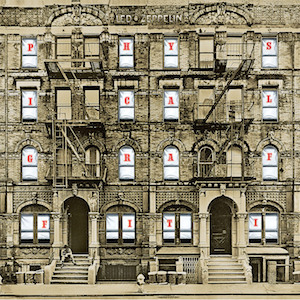
Released 40 years to the day after the original 1975 double album, this 2015 deluxe reissue is part of Jimmy Page’s celebrated remastering campaign that had already worked through the band’s first five albums to widespread acclaim, including a Classic Rock “Reissue of the Year” award. Physical Graffiti itself remains the definitive statement of Led Zeppelin’s stylistic range — blues, folk, hard rock, world music, and boogie-woogie all crammed into one sprawling double LP — and this deluxe edition presents the newly remastered original album across two LPs, plus a third disc of previously unreleased companion audio: rough mixes and alternate versions of several key tracks.
The Pressing
Reaction to this pressing has been notably more divided than some of the earlier reissues in the campaign, and it’s worth going in with your eyes open. On the positive side, plenty of listeners report a genuinely quiet, well-mastered pressing — flat, detailed, and free of major surface noise, with several reviewers specifically praising the vinyl’s overall quality control as among the better options currently available for this album. The packaging is a clear highlight: a faithfully reproduced die-cut windowed sleeve replicating the original’s distinctive artwork, a Swan Song label design that collectors have enjoyed, and (depending on edition) a replica 1975 promotional poster as a nice bonus.
That said, there’s real inconsistency reported across individual copies. At least one listener described their copy as among the worst-sounding new pressings they’d encountered, while others found specific pressing defects — including an audible pop during the opening keyboard intro of “In the Light.” The standard paper inner sleeves have also been criticized as underwhelming for a release of this stature, lacking the archival-quality lining you might expect. On balance, most reports lean positive — genuinely quiet vinyl with good detail — but this is one of the more QC-variable entries in the reissue campaign, so it’s worth inspecting your copy carefully after purchase.
LP1 – Side One
- Custard Pie — A driving, blues-rock opener built around a nasty, funky riff — a strong way to kick off such a sprawling record, with the low end given real weight on a good pressing.
- The Rover — Melodic and expansive, blending hard rock energy with a surprisingly optimistic lyrical outlook. The layered guitar work benefits from the pressing’s overall clarity.
- In My Time of Dying — An extended, gospel-blues epic driven by Page’s slide guitar and Bonham’s thunderous drumming. At over 11 minutes, it’s a genuine dynamic showcase, and the quieter passages reward a clean, low-noise copy.
LP1 – Side Two
- Houses of the Holy — Upbeat and hook-driven, originally intended for the previous album, it fits comfortably here as an energetic mid-record moment.
- Trampled Under Foot — Funky, keyboard-driven, and utterly infectious — one of the album’s most beloved tracks, with a groove that comes through strongly on this pressing’s low end.
- Kashmir — The album’s towering centerpiece and arguably the band’s most ambitious composition, built on a hypnotic, Eastern-influenced riff and sweeping orchestration. It’s a genuine highlight of the whole set, and the clarity in the high end serves the strings and cymbal work well.
LP2 – Side One
- In the Light — A slow-building, atmospheric epic featuring some of John Paul Jones’s most distinctive synthesizer work. The dynamic swings here are considerable, and this is one of the tracks where pressing quality really matters — some listeners specifically flagged issues on this track’s opening.
- Bron-Yr-Aur — A brief, delicate acoustic instrumental that offers a lovely change of pace — quiet, intimate, and a good test of a pressing’s noise floor.
- Down by the Seaside — Melodic and gentle, with a country-folk lilt that shows a different, softer side of the band.
- Ten Years Gone — A sprawling, emotionally rich epic with multiple layered guitar parts — one of the album’s most rewarding deep cuts, and a genuine showcase for a pressing with good separation and detail.
LP2 – Side Two
- Night Flight — Upbeat and hook-driven, a relatively straightforward rock track that provides good momentum heading into the album’s back stretch.
- The Wanton Song — Riff-heavy and aggressive, with a memorable central hook and plenty of energy.
- Boogie with Stu — A loose, piano-driven jam featuring Ian Stewart of the Rolling Stones, capturing a genuinely fun, off-the-cuff energy.
- Black Country Woman — An acoustic, front-porch blues number with a charmingly rough, live-in-the-room feel.
- Sick Again — A driving, riff-heavy closer that brings the album full circle with real energy, ending the record on an appropriately loud note.
Final Verdict
Physical Graffiti remains one of the greatest and most ambitious double albums in rock history, and this deluxe reissue mostly does it justice — attractive, faithful packaging, a genuinely well-regarded remaster from Jimmy Page, and a bonus disc of alternate takes that offer a fascinating glimpse into the album’s creation for serious fans. The catch is consistency: while many pressings sound genuinely excellent, quiet, and detailed, enough reports of pressing defects and QC variance have surfaced that it’s worth being a little more careful with this one than with some of the campaign’s earlier, more uniformly praised releases. If you get a good copy, it’s a fantastic way to experience an essential album; just don’t assume every copy in the wild is flawless.