 Vinyl Review
Alice Cooper – Special Forces
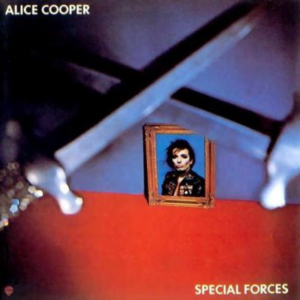
Back to The Den in Poole for another dig through the crates, and this one turned out to be a different kind of find altogether — a shift from prog and orchestral rock into something louder and considerably more theatrical. The rock/hard rock section had a couple of other things worth a second look: a slightly rough UK pressing of Girlschool’s Hit and Run, and a Saxon LP with a cracked but structurally sound sleeve. But it was the stark, military-stencilled cover art that caught my eye first — a UK pressing of Alice Cooper’s Special Forces. The sleeve showed some genuine handling, a soft corner ding and light shelf wear, but nothing that put me off. It came home with me from Poole.
Special Forces is Alice Cooper’s thirteenth studio album, released on Warner Bros. in September 1981. It arrived during one of the most turbulent stretches of Cooper’s career, made and released during the period he’s since described as his “blackout years,” when addiction had taken a heavy toll. Produced by Richard Podolor, the record continues the leaner, harder-edged direction of the previous year’s Flush the Fashion, trading the theatrical glam-rock of the ’70s for a tighter, new wave and punk-inflected sound wrapped in a militaristic theme — reflected in the album’s stencilled artwork, Cooper’s stage costuming for the era, and the tour that followed.
Track by Track
Side One
- Who Do You Think We Are — A sharp, propulsive opener that sets the record’s confrontational tone straight away. Co-written with keyboardist Duane Hitchings, it’s one of the record’s more muscular moments and remained a live staple for years after the rest of the album was largely forgotten.
- Seven and Seven Is — A cover of the 1966 Love garage-rock classic, sped up and roughened for the era. It’s a strange, effective fit — barely over two and a half minutes, all nervous energy.
- Prettiest Cop on the Block — Playful and a little sleazy in classic Cooper fashion, riding a stiff new wave groove rather than the sludgy riffs of his earlier work.
- Don’t Talk Old to Me — A snappy, dismissive strut of a track, short and pointed, very much in keeping with the album’s punk-adjacent leanings.
- Generation Landslide ’81 (Live) — A live reworking of the 1973 Billion Dollar Babies track, included here as a bridge between eras. Its presence feels almost like Cooper checking in with his own past mid-album.
Side Two
- Skeletons in the Closet — One of the stronger cuts on side two, moody and hook-laden, with a chorus built for arenas even if the album’s stripped-down production keeps things comparatively lean.
- You Want It, You Got It — The album’s lead single. Driving and radio-friendly, it’s probably the closest Special Forces comes to a genuine hit, though it never quite broke through commercially.
- You Look Good in Rags — Tongue-in-cheek and a bit throwaway, but energetic — the kind of track that works better in the flow of the album than as a standalone.
- You’re a Movie — A slower, more deliberate track, with a hint of the theatrical grandeur Cooper had largely set aside for this record.
- Vicious Rumours — A fittingly cynical closer, sneering and a touch paranoid, bringing the record’s harder edges to a close without much ceremony.
Special Forces is a curious, uneven record — not one of Cooper’s essential albums, but a genuinely interesting document of an artist in flux, both musically and personally. The new wave and punk influences sit oddly alongside his theatrical instincts, and the production is noticeably leaner than the elaborate concept records of the ’70s, which some longtime fans found jarring at the time. But there’s a nervy, of-the-moment energy running through it that’s easy to overlook if you’re only listening for another Welcome to My Nightmare. On UK vinyl, that stripped-back mix has a directness that suits the record’s stencilled, militaristic packaging — this was never meant to sound lush. Not the first Alice Cooper record I’d recommend to someone starting out, but a fascinating one for anyone already invested in his catalogue, and another reminder that Poole’s shops reward a slow afternoon with no fixed shopping list.