 Vinyl Review
Mike Oldfield — Tubular Bells (1973)
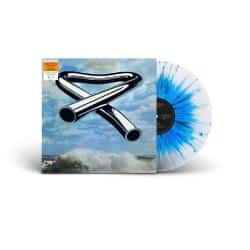
2026 National Album Day edition: limited “Blue Seashore” coloured vinyl
Label: Universal (UMC) / Virgin · Mastering: 2023 half-speed master by Miles Showell at Abbey Road · National Album Day: Saturday 18 October 2026 · Theme: “Icons”
Introduction
Tubular Bells should never have worked. A shy 19-year-old multi-instrumentalist from Reading wrote a 49-minute instrumental with no vocals, no singles and no band, in two side-long movements. He played almost every instrument himself, built it up through overdub after overdub, and was turned down by nearly every record company in London.
Then a young record-shop entrepreneur named Richard Branson launched a label to put it out. Tubular Bells became catalog number V2001, Virgin Records’ very first release, on 25 May 1973. It spent years in the UK charts, and its opening theme ended up in one of the most terrifying horror films ever made. It sold millions of copies, and the money it made built the Virgin empire.
Fifty-three years later it’s back as one of the “Icons & Inspirations” titles for National Album Day 2026, pressed on blue “seashore” vinyl that recalls the sea-and-sky backdrop of Trevor Key’s iconic cover.
Track Listing
Tubular Bells is two long pieces, one per side. The section names below come from fans and later releases; the original sleeve lists only “Part One” and “Part Two.”
Side One — Tubular Bells (Part One) · approx. 25:30
The opening theme
This is the famous piano figure in a shifting 15/8 + 16/8 pattern, written partly in 7/8. It’s hypnotic and slightly unsettling. Oldfield plays it on piano, with glockenspiel and organ shadowing it. William Friedkin chose it for The Exorcist without Oldfield’s involvement, and its eerie repetition became synonymous with dread.
The development sections
Oldfield moves through a long sequence of moods: folky acoustic passages, bursts of fuzz guitar, pastoral organ and a strange “Spanish”-style section. The transitions are seamless and full of melodic invention. Listen for his distinctive guitar tone, sustained and singing, almost like a voice.
The finale and the “Master of Ceremonies”
This is the most famous part of the album. Over a repeating bass riff, the Bonzo Dog Doo-Dah Band’s Vivian Stanshallannounces each instrument in his plummy, theatrical voice as it enters: “Grand piano… Reed and pipe organ… Glockenspiel… Bass guitar… Double-speed guitar… Two slightly distorted guitars… Mandolin… Spanish guitar and introducing acoustic guitar… Plus… tubular bells!” When the bells crash in, it’s one of rock’s great payoffs. The side closes with a quiet acoustic coda.
Side Two — Tubular Bells (Part Two) · approx. 23:20
The pastoral opening
This is a gentle, folk-influenced, almost Celtic section of acoustic guitar, organ and a wordless “nasal choir.” Oldfield’s sister Sally Oldfield and Mundy Ellis contribute vocals. The mood is warm and English-countryside, reflecting the album’s rural Oxfordshire birthplace.
The “Bagpipe Guitars”
Oldfield layers heavily processed guitar lines to imitate bagpipes. It’s one of the album’s most inventive tricks, years before guitar synthesizers made this sort of thing easy.
“Caveman” (the “Piltdown Man” section)
This is a sudden, bizarre turn. Oldfield, reportedly after a bottle of whisky, growls and screams over heavy drums and riffs. It’s unhinged, funny and completely unexpected. The section is often called “Piltdown Man” after the famous fossil hoax. Some listeners find it jarring, but it keeps the album unpredictable.
The ambient passage and “The Sailor’s Hornpipe”
After a long, beautiful ambient guitar-and-organ passage, the record ends with a jaunty, speeded-up version of the traditional “Sailor’s Hornpipe.” On the original sessions, an alternative version reportedly had Stanshall leading a drunken tour of the Manor; that take appeared on later box sets. It’s a cheeky, very English ending.
Recording and Enthusiast Details
The Manor and the people behind it
- Studio: The Manor Studio at Shipton-on-Cherwell, Oxfordshire. Branson had just bought the country house and converted it into Virgin’s residential studio. Oldfield was a session musician there in 1972, and the house engineers heard his demos.
- Producers and engineers: Tom Newman and Simon Heyworth, with Oldfield, produced the album. They also did most of the engineering. Newman and Heyworth were the Manor’s in-house team, and they championed the project from the start. Oldfield was given studio time in gaps between paying clients, often late at night.
- The overdubs: Oldfield built the album layer by layer on a 16-track tape machine and bounced tracks to make room for more. The often-quoted figure of “2,300 overdubs” is a legend that’s probably exaggerated, but there were certainly far more parts than tracks. Repeated bouncing on analogue tape added hiss and loss with each generation, and Newman and Heyworth had to manage this carefully.
- The tubular bells: the bells were hired for the session. Oldfield famously struck them with a hammer, not the proper mallet, to make them loud and aggressive enough. The result is the distorted, ringing clang heard at the end of Part One.
- Other musicians: although Oldfield played most of it, guests included:
- Vivian Stanshall: Master of Ceremonies
- Jon Field: flutes
- Lindsay Cooper: string basses
- Steve Broughton: drums on Part Two
- Sally Oldfield and Mundy Ellis: vocals (the “nasal chorus”)
- “The Manor Choir”: Oldfield, Newman and others
Release and phenomenon
- Rejection: before Virgin, Oldfield’s demo was turned down by many major labels. Branson and Virgin’s Simon Draper started the label partly so they could release it.
- First live performance: 25 June 1973 at the Queen Elizabeth Hall, London, with musicians including Mick Taylor of the Rolling Stones and Steve Hillage. Oldfield, crippled by stage fright, nearly refused to go on. Branson persuaded him reportedly by giving him his Bentley.
- The Exorcist: William Friedkin used the opening for his 1973 film. In the US, an edited single of the theme reached No. 7 on the Billboard Hot 100 in 1974. Oldfield disliked the edit, which was made without his approval.
- Charts: in the UK, the album reached No. 1 in October 1974, more than a year after release, replacing Oldfield’s own second album, Hergest Ridge. It spent over 270 weeks on the UK chart.
- Awards: Grammy for Best Instrumental Composition (1975).
- Sales: estimated at 15–17 million copies worldwide.
The cover
Trevor Key photographed the “bent bell” sculpture against a sea and sky backdrop. The cover is part of the reason this edition is called “Blue Seashore.” Key also designed many later Oldfield and Virgin covers.
Versions and sequels
- Quadraphonic mix (1974): produced by Phil Newell and highly prized by collectors. It was later reissued in surround on SACD and Blu-ray.
- The Orchestral Tubular Bells (1975): David Bedford’s orchestral arrangement with the Royal Philharmonic Orchestra.
- Sequels: Tubular Bells II (1992), III (1998) and The Millennium Bell (1999). In 2003, Oldfield re-recorded the original as Tubular Bells 2003. Tubular Beats (2013) is a remix collection, and Tubular Bells 4 was released in 2023.
- London 2012 Olympics: Oldfield performed the piece during the opening ceremony, in Danny Boyle’s NHS segment.
- The 2023 50th Anniversary edition: a half-speed master by Miles Showell at Abbey Road. The anniversary 2LP edition also included “Tubular X” (Oldfield’s X-Files reworking), a YORK remix and the 2012 Olympic version. The JB Hi-Fi listing says this NAD 2026 pressing uses the same half-speed master. The listing doesn’t say whether the bonus material is included, so it may well be the album alone.
About this pressing
- Half-speed mastering: the lacquer is cut at half the normal speed while the master plays at half speed. This allows more precise cutting, especially of high frequencies and transients. Miles Showell is one of the best-known specialists in the technique. His Abbey Road half-speed masters have generally been well received, though some listeners find them less punchy than the best original Virgin pressings.
- Coloured vinyl caveat: blue or marbled vinyl can have a slightly higher noise floor than black. That matters for Tubular Bells, with its long quiet passages, especially the ambient sections of Part Two and the quiet opening of Part One. Check copies for surface noise.
- Availability: National Album Day editions are limited, and JB Hi-Fi NZ already lists this one as unavailable. Expect demand from Oldfield collectors.
- Original pressings: for comparison, early UK Virgin V2001 pressings are widely available. The first-pressing labels are the green and cream “twins” design. Matrix and stamper details identify the earliest cuts, which some collectors still consider the best-sounding.
Final Thoughts
Tubular Bells is a one-off: a teenager’s handmade symphony, assembled from scratch in a country house with two sympathetic engineers and a mountain of overdubs. It isn’t flawless. The “Piltdown Man” section is divisive, the hornpipe ending is a bit throwaway, and some transitions wander. But the ambition and melodic invention are astonishing, and the climax of Part One is one of the most satisfying moments in recorded music.
It’s also historically important. It launched Virgin Records, helped define progressive rock and new-age instrumental music, and proved that a long-form instrumental album could become a mass-market phenomenon.
Highlights: the opening theme, the Stanshall-introduced finale of Part One, the pastoral opening of Part Two.
Weakest moment: the “Piltdown Man” section, depending on your taste.
On this pressing: Miles Showell’s half-speed master is a respected modern version, and the blue seashore vinyl looks the part. If you want the best possible sound, a clean original Virgin pressing or the quadraphonic mix may still have the edge. As a collectable, though, this edition is very appealing.