 Vinyl Review
Pink Floyd — Meddle (1971)
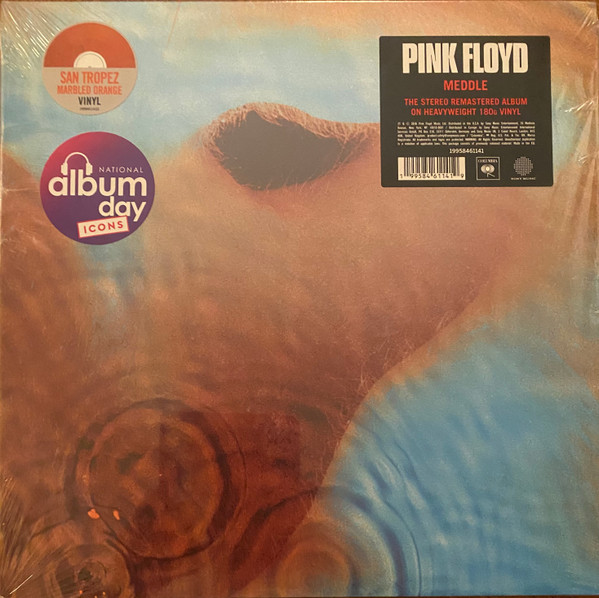
2026 National Album Day edition: limited 180g “San Tropez” orange marbled vinyl
Label: Columbia / Sony Music · Catalog: 88875184231 · Barcode: 199584661141 · Released: 17 October 2026
Introduction
Meddle is the album where Pink Floyd found themselves. After Syd Barrett left in 1968, the band spent three years making uneven records: the half-studio, half-live Ummagumma, film soundtracks, and Atom Heart Mother, an ambitious album with orchestra and choir. Released in late 1971, Meddle is where Roger Waters, David Gilmour, Richard Wright and Nick Mason first worked as a true unit. It’s also where the sound that would make The Dark Side of the Moon a phenomenon two years later first came into focus: patient, spacious, melodic and rich in texture.
The record has an odd shape. Side one is a mixed collection of five short pieces: a ferocious instrumental, two gentle folk songs, a jazzy lounge tune and a novelty blues sung by a dog. Side two is entirely taken up by “Echoes,” a 23-minute piece that many fans regard as the band’s finest achievement.
This review looks at the music and at the new National Album Day pressing, which came out today.
Track Listing
Side One
1. One of These Days (Waters/Wright/Mason/Gilmour) · 5:57
This is one of the most menacing openers in rock. Waters and Gilmour both play bass, fed through a Binson Echorec delay unit, and the result is a pulsing, galloping figure in which the repeats lock to the tempo. Wind howls, the tension builds, and then comes the band’s only spoken “vocal” from Nick Mason. His threat, “One of these days I’m going to cut you into little pieces,” is slowed and distorted into something monstrous. Then the band crashes in with lap steel and Hammond organ. Listen for the brief nod to the Doctor Who theme. It became a live staple for years.
2. A Pillow of Winds (Waters/Gilmour) · 5:10
This one is a sudden drop into stillness. It’s a pastoral acoustic piece in alternate tuning with soft slide guitar, and Gilmour sings it in a near whisper. The title reportedly comes from a scoring hand in mahjong, which the band played on tour. It’s one of the band’s few true love songs, and one of the loveliest things in their catalog.
3. Fearless (Waters/Gilmour) · 6:08
This is a stately, open-tuned acoustic song about standing firm against the crowd. Its famous coda fades in a recording of Liverpool FC fans on the Kop singing “You’ll Never Walk Alone.” Mixing a terrace chant with a quiet folk-rock song shouldn’t work, but it’s oddly moving. Waters was an Arsenal fan, not a Liverpool one, and that adds a nice irony.
4. San Tropez (Waters) · 3:43
This is Waters alone, with a breezy, jazzy shuffle about lazy days on the Riviera, and the song this pressing is named after. Wright’s cocktail piano and Gilmour’s slide carry it. It’s slight, but it’s a charming glimpse of a relaxed Waters before the darker concept albums.
5. Seamus (Waters/Wright/Mason/Gilmour) · 2:15
This is the album’s notorious novelty track. Gilmour was looking after Seamus, a dog belonging to Humble Pie’s Steve Marriott, and discovered it howled along whenever music played. The band built a simple acoustic blues around it. The band themselves later dismissed it, and many listeners treat it as the moment to flip the record over early. Its stranger cousin, “Mademoiselle Nobs,” which features a different dog, appears in Live at Pompeii.
Side Two
6. Echoes (Waters/Wright/Mason/Gilmour) · 23:31
This is the reason Meddle matters. It grew out of weeks of experimental studio jams, which the band labeled “Nothings” (working titles included “Return of the Son of Nothing”). From those fragments they built a structured epic in several movements:
- “The ping”: a single high piano note played through a Leslie rotating speaker, sounding like sonar from the deep. It came about by accident, when Wright’s piano was routed through the Leslie.
- The verses: Gilmour and Wright sing in close harmony, with lyrics about oceans, albatrosses and human connection. These are early seeds of Waters’s empathy themes.
- The funk jam: a swinging, extended groove with soaring Gilmour lead guitar.
- The “whale” section: an eerie, rhythmless soundscape of wind and shrieking “seagull” cries. Gilmour created them by plugging his wah-wah pedal in backwards and dragging the guitar slide across the strings.
- The return: a slow build back into the main theme, a final verse, and a rising chord sequence that dissolves into Shepard-tone-like ascending vocals.
Wright and Gilmour’s partnership is at its peak here. Waters later noted that the chromatic riff resembled part of Andrew Lloyd Webber’s The Phantom of the Opera (1986), though he never took legal action. Fans also enjoy syncing “Echoes” with the “Jupiter and Beyond the Infinite” sequence of 2001: A Space Odyssey.
Recording and Enthusiast Details
Studios and engineering
- Recorded: January to August 1971, across three London studios:
- EMI Studios (Abbey Road), with engineers including Peter Bown and a young John Leckie, who later produced XTC, the Stone Roses and Radiohead’s The Bends.
- Morgan Studios in Willesden, with engineers Rob Black and Roger Quested.
- AIR Studios, George Martin’s facility. Its 16-track machines were a draw, since Abbey Road was still largely 8-track at the time.
- Producer: Pink Floyd, credited as a band. It was the first album the band fully self-produced without an outside producer.
- Working method: Unlike later Pink Floyd albums, Meddle was built from studio experiments rather than pre-written songs. “Echoes” was pieced together from dozens of separately recorded fragments, a laborious editing job in the days of analogue tape.
The cover
The sleeve is by Hipgnosis (Storm Thorgerson and Aubrey Powell). It shows a close-up of an ear underwater, with ripples crossing it to suggest sound waves. The photograph is by Bob Dowling. The band wanted a baboon’s anus, and the ear was the compromise. Thorgerson later said he was unhappy with the result, and Mason has called it one of his least favorite Pink Floyd covers. The gatefold inside shows the band photographed by Dowling.
Release and reception
- Released: 30 October 1971 in the US (Harvest/Capitol) and 5 November 1971 in the UK (Harvest).
- Charts: No. 3 in the UK. In the US it was a modest No. 70, though over the decades it went double platinum there.
- Reception: Critics were generally positive, especially about “Echoes.” Today it is widely regarded as the essential bridge between psychedelic Pink Floyd and the Dark Side era.
Further connections
- Live at Pompeii (1972): “Echoes” was filmed in the empty Roman amphitheatre, split across the film’s beginning and end. It’s the definitive performance of the era.
- Crystal Voyager (1973): surf filmmaker George Greenough set his 23-minute final sequence, filmed from inside breaking waves, to “Echoes.” A restored 4K version of that sequence premieres on Pink Floyd’s YouTube channel today, alongside this release.
- Abbreviated “Echoes”: a shortened 16-minute edit appeared on the 2001 compilation Echoes: The Best of Pink Floyd, a version purists have mixed feelings about.
About This Pressing: 2026 National Album Day Edition
- What it is: a limited one-off pressing for the UK’s National Album Day (17 October 2026). It’s on 180g “San Tropez” orange marbled vinyl, named after side one’s fourth track. Retailers warn that “colour may vary,” which is normal for marbled pressings since each disc’s swirl is unique.
- Source of the audio: the catalog number 88875184231 matches Sony/Columbia’s numbering for the 2016 Pink Floyd Records remaster campaign. That series was remastered from the original analogue tapes by James Guthrieand Joel Plante, with lacquers cut by Bernie Grundman. The new barcode (199584661141) marks a new manufacture. Sony hasn’t said whether the lacquers were newly cut or the 2016 parts were reused, so treat it as most likely the 2016 remaster unless the sleeve credits say otherwise.
- Color vinyl caveat: marbled and colored vinyl can have a slightly higher noise floor than standard black, and pressing quality varies between batches. The quiet passages of “Echoes,” such as the ping, the whale section and the long fades, are the ideal test. Check a copy closely on arrival for surface noise and off-center pressing.
- Collectability: National Album Day editions are limited and often sell out quickly. At least one retailer, JB Hi-Fi NZ, already lists it as unavailable. Expect secondary-market premiums.
Final Thoughts
Meddle is a record of two halves, and both reveal something. Side one is an engaging, if uneven, sampler of everything Pink Floyd could do in 1971. It holds a monster instrumental, two beautiful acoustic songs, a lightweight jazz trifle and a dog. Side two is a masterpiece. “Echoes” is the moment the four musicians first found the shared language they would use on Dark Side, Wish You Were Here and beyond. Many fans would argue they never surpassed it.
Highlights: “Echoes,” “One of These Days,” “A Pillow of Winds.”
Weakest moment: “Seamus.”
On the pressing: the orange marbled edition is an attractive collector’s piece with a fitting name. If it uses the 2016 Guthrie/Plante/Grundman remaster, the mastering is excellent. If you want a pressing purely for listening, a standard black 2016 pressing or a good early Harvest original may still be the safer choice. If you want this one, buy soon, as limited NAD stock tends to go quickly.