 Vinyl Review
Paul McCartney & Wings — Band on the Run (1973)
Label: Apple · Producer: Paul McCartney · Released: December 1973
Introduction
By 1973 Paul McCartney had something to prove. Since the Beatles split, critics had been unkind. McCartney (1970) and Ram (1971) were dismissed as lightweight, and Wings’ first two albums, Wild Life and Red Rose Speedway, did little to change minds. John Lennon’s barbs in “How Do You Sleep?” didn’t help.
So McCartney decided to make his next record somewhere exotic, and chose EMI’s studio in Lagos, Nigeria. Almost everything went wrong. Two members quit the night before the band left. In Lagos he was mugged and lost his demo tapes. He collapsed with a breathing problem. A furious local music legend accused him of stealing African music.
Somehow, he came back with his best post-Beatles album. Band on the Run reached No. 1 in the UK and the US, won two Grammys and restored his reputation. Even Lennon praised it.
Track Listing (UK edition)
Side One
1. Band on the Run
A five-minute mini-suite in three parts that echoes the medleys on Abbey Road. It opens with a slow, trapped lament (“Stuck inside these four walls“), shifts into a heavy, bluesy middle section, and breaks out into the joyful, acoustic escape of the title section. McCartney said the lyric was partly inspired by a remark George Harrison made in a business meeting about the Beatles becoming “prisoners.” It was a hit, reaching US No. 1 and UK No. 3.
2. Jet
A glam-rock stomper with a huge riff, synthesizer, horns and a shouting chorus. McCartney has said the name came from one of his pets, a pony or a dog depending on the telling. The lyrics are gloriously nonsensical. It’s one of his best rock songs, and it was a Top 10 hit in both countries.
3. Bluebird
A soft, sunny acoustic love song with gentle percussion and a lovely saxophone solo from Howie Casey. It’s a close cousin of “Blackbird.”
4. Mrs. Vandebilt
A bouncy, playful song with a chanting “Ho, hey ho” chorus. It’s a cult favourite, and it has become hugely popular in Eastern Europe and Russia.
5. Let Me Roll It
A heavy, echo-drenched blues with a fat, distorted guitar riff. Many listeners hear it as a homage to Lennon, since the vocal echo sounds very like Lennon’s Plastic Ono Band sound. McCartney has played it live for decades.
Side Two
6. Mamunia
A breezy, warm song named after a famous hotel in Marrakesh. “Mamunia” is often said to mean “safe haven.” It has a gentle, rain-soaked feel, and in the lyric the rain is a blessing rather than a complaint.
7. No Words
A short, pretty song co-written with Denny Laine. It’s one of the album’s lesser-known moments, with a nice guitar solo.
8. Picasso’s Last Words (Drink to Me)
This is the album’s most unusual piece. In Jamaica, actor Dustin Hoffman challenged McCartney to write a song on the spot, using a news story about Pablo Picasso‘s final words: “Drink to me, drink to my health, you know I can’t drink anymore.” McCartney immediately came up with a melody. The finished track is a collage, with Cubist-style shifts, a French-music-hall section and snippets of other songs from the album, recalling Picasso’s fragmented paintings. Part of it was recorded at drummer Ginger Baker‘s ARC Studio in Lagos.
9. Nineteen Hundred and Eighty Five
A dramatic piano-driven rocker that builds and builds, with Mellotron and orchestra, into a huge climax. It then fades into a reprise of the “Band on the Run” chorus. It’s a superb finale.
The US edition added “Helen Wheels,” a Wings single named after McCartney’s Land Rover, to the track list. Capitol insisted on it, and McCartney agreed.
Recording and Enthusiast Details
Lagos
- Why Lagos? McCartney wanted somewhere exotic and sunny to record, and EMI had a studio in Lagos. He reportedly imagined lounging on beaches. The reality was a rainy season, and a studio that was poorly equipped and still being finished.
- The band falls apart: just before they left, guitarist Henry McCullough quit after an argument, and drummer Denny Seiwell dropped out the night before departure. The band was down to a trio: Paul McCartney, Linda McCartney (keyboards and vocals) and Denny Laine (guitars and vocals). McCartney ended up playing drums, most of the bass and much of the guitar himself.
- The mugging: one night, Paul and Linda were robbed at knifepoint. The thieves took a bag containing cassettes of demos and handwritten lyrics. McCartney had to recreate the songs from memory.
- The collapse: McCartney also suffered a frightening breathing problem in the studio, a bronchial spasm, likely brought on by stress, heat and heavy smoking. He collapsed, and he later recalled that Linda thought he was dying.
- Fela Kuti: the Afrobeat legend accused McCartney publicly of coming to Nigeria to steal African music. McCartney invited him to the studio and played him the songs. They clearly weren’t African-influenced, and Fela accepted this. McCartney later called Fela’s band one of the most extraordinary he had ever seen.
The people
- Engineer: Geoff Emerick, who had engineered Revolver, Sgt. Pepper and Abbey Road. He won the Grammy for Best Engineered Recording (Non-Classical) for this album, his second, after Sgt. Pepper.
- Orchestral arrangements: Tony Visconti, best known as David Bowie and T. Rex’s producer.
- Saxophone: Howie Casey, an old friend from the Beatles’ Hamburg days.
- Studios: basic tracks were recorded at EMI Studios, Lagos. Overdubs, orchestra and mixing were done at AIR Studios in London.
The cover
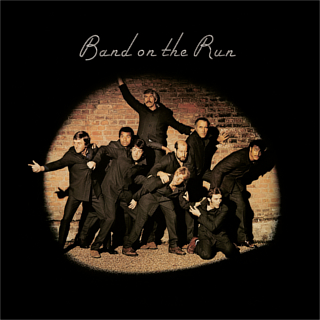
The famous cover was photographed by Clive Arrowsmith at Osterley Park in west London. It shows the band, plus celebrity “prisoners,” caught in a searchlight as they escape from jail. The celebrities were:
- Michael Parkinson, TV presenter
- Kenny Lynch, singer and comedian
- James Coburn, Hollywood actor
- Clement Freud, broadcaster and politician
- Christopher Lee, horror legend
- John Conteh, boxing champion
McCartney has said the slightly hazy, golden look comes from the low light and the fact that everyone was a little drunk after a party.
Awards and success
- Grammys: Best Pop Vocal Performance by a Duo, Group or Chorus (for the title track), plus Geoff Emerick’s engineering award.
- Charts: No. 1 in the UK and the US. In the UK, it spent over a year on the chart and became the best-selling studio album of 1974.
Pressings
- Original pressings: the original 1973 Apple pressings are common and generally cheap. UK copies came with a poster and lyric inner sleeve, and complete copies are worth more.
- 2010 Archive Collection: McCartney’s archive reissue of the album, with bonus material and a remaster.
- 50th anniversary edition (2024): reissued with a half-speed master from Abbey Road. It also included an “Underdubbed” mix, which presents the songs as they were before many of the overdubs were added. Check whether yours is a standard pressing or the anniversary edition.
Final Thoughts
Band on the Run is McCartney’s best album after the Beatles. Despite every disaster in Lagos, it sounds confident, joyful and full of invention. The title track and “Jet” are among the best things he ever recorded, “Let Me Roll It” and “1985” show how hard he could rock, and “Picasso’s Last Words” shows his inventive, playful side.
Some of the lesser songs, like “No Words” and “Mamunia,” are pleasant rather than brilliant. But the album flows beautifully and sounds as good now as it did in 1973.
Highlights: “Band on the Run,” “Jet,” “Let Me Roll It,” “Nineteen Hundred and Eighty Five.”
Weakest moment: “No Words.”