 Vinyl Review
Def Leppard — Hysteria (1987)
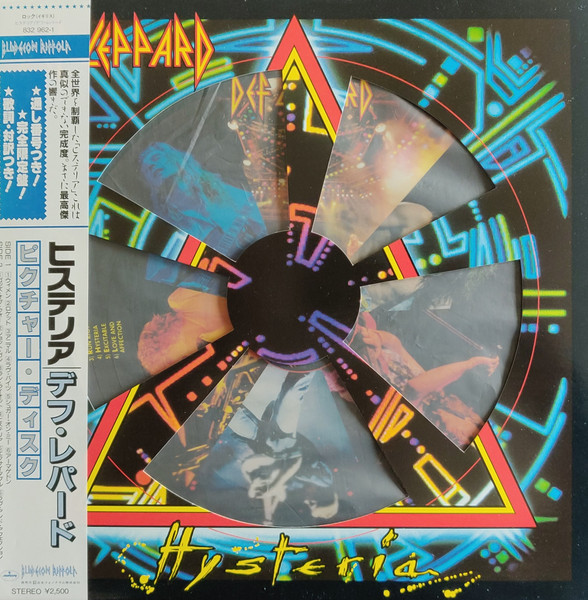
This copy: Bludgeon Riffola / Phonogram HYSPD 1 / 832 962-1 · Picture disc LP · 1988 · listed as Japan
Producer: Robert John “Mutt” Lange · Original release: 3 August 1987
Introduction
Few albums were made through as much hardship as Hysteria, or became as big. Def Leppard were a young heavy metal band from Sheffield. Their third album, Pyromania (1983), produced by Robert John “Mutt” Lange, sold millions in America and made them stars. The follow-up was meant to be bigger still.
Instead the band went through nearly four years of disasters. Producers came and went. Money ran out. And on 31 December 1984, drummer Rick Allen lost his left arm in a car crash near Sheffield.
The band refused to replace him. Allen learned to play again using a custom electronic kit with foot pedals. Lange came back, and the band made an album that went far beyond heavy metal. It was designed, in Lange’s words, to be a rock album in the spirit of Michael Jackson’s Thriller, where every song could be a hit single.
It worked. Hysteria reached No. 1 in the UK and the US, produced seven US singles, and has sold over 25 million copies. It’s one of the best-selling rock albums of all time.
Track Listing
All songs written by Def Leppard and Mutt Lange (Steve Clark, Phil Collen, Joe Elliott, Rick Savage and Lange, with various combinations credited).
Side One
1. Women
A heavy, mechanical opener with a stomping riff. It was the first US single, but it’s not as strong as what follows.
2. Rocket
A hypnotic, tribal track built on a Burundi-style drum pattern, with layered vocals, backwards effects and a chant name-checking the band’s 1970s heroes, from Elton John and David Bowie to Queen. Its long, psychedelic middle section uses tape loops and reversed sounds. It’s one of the album’s most inventive tracks.
3. Animal
A polished, irresistible pop-rock song. It reportedly took about three years to finish, which shows Lange’s perfectionism. It became the band’s first UK Top 10 single, reaching No. 6.
4. Love Bites
A dark, brooding power ballad, and the band’s only US No. 1 single. Mutt Lange brought it to the band largely written, which was unusual for them.
5. Pour Some Sugar on Me
The album’s biggest song, and famously the last one written. Joe Elliott was playing an acoustic riff in the studio during a break, and Lange heard it and insisted they work on it. It was finished in about two weeks. Its stuttering, hip-hop-influenced rhythm and chanted vocals were unusual for rock. It became a hit in the US, partly thanks to strip clubs, where dancers loved it, and reached US No. 2. It’s now one of the defining songs of 1980s rock.
6. Armageddon It
A bouncy, playful, glam-flavoured song with a T. Rex-like stomp and a pun in the title. It reached US No. 3.
Side Two
7. Gods of War
The album’s heaviest, darkest track, about the Cold War. It includes samples of speeches by Ronald Reagan and Margaret Thatcher.
8. Don’t Shoot Shotgun
A punchy, mid-tempo rocker. It’s solid, but a lesser track by the album’s standards.
9. Run Riot
The album’s fastest, most aggressive song, closest to the band’s early metal sound.
10. Hysteria
The title track is a beautiful, atmospheric, melancholy pop song with chiming guitars and dreamy harmonies. Rick Savage wrote the main riff. It reached the US Top 10 and is one of the band’s finest moments.
11. Excitable
A funky, danceable track with a strong groove. It’s the album’s most experimental song.
12. Love and Affection
A strong, anthemic closer with a big chorus. It was nearly a single.
Recording and Enthusiast Details
The long, troubled making
- Mutt Lange is unavailable: after Pyromania, Lange was exhausted. The band began Hysteria in 1984 with Jim Steinman, best known for Meat Loaf’s Bat Out of Hell, as producer. It didn’t work, and Steinman was fired.
- The studios: after moving between studios, the band settled at Wisseloord Studios in Hilversum, the Netherlands. Further work was done at Windmill Lane in Dublin and in London. Part of the reason for working outside the UK was tax.
- Rick Allen’s accident (31 December 1984): Allen lost control of his Corvette on the A57 near Sheffield, and his left arm was severed. Doctors reattached it, but infection forced its amputation. With the band’s support, Allen learned to play again, using a custom electronic Simmons kit with foot pedals that triggered sounds his left arm would have played. His first major show back was the Monsters of Rock festival at Donington in August 1986, where he received an emotional standing ovation.
- Mutt Lange’s accident: Lange came back in 1985, but he was then injured in a car crash himself, delaying things further.
- The cost: the album took nearly three and a half years and is said to have cost over $4.5 million. The band would have been bankrupt if it hadn’t sold. Lange insisted it had to sell millions just to break even.
Production
- Mutt Lange’s technique: Lange was famous for perfectionism, recording each guitar note separately and building huge choral backing vocals from hundreds of layered overdubs. The guitars were often recorded direct rather than through amplifiers, using the Rockman headphone amp and similar devices. That gives the album its smooth, processed, polished sound.
- Engineer: Nigel Green. Mike Shipley mixed it.
- Drums: most of Allen’s parts were played on the electronic kit, combined with samples and programming. That’s why the drums sound so precise and huge.
The cover
The artwork, with its stylised face, was designed by Andie Airfix of Satori, who also designed the covers of Pyromaniaand later Def Leppard albums.
After Hysteria
- Guitarist Steve Clark died in January 1991 at the age of 30, after years of struggling with alcohol. He had been a central songwriter on Hysteria.
- The band carried on with Adrenalize (1992) and remain a huge live act today. They were inducted into the Rock and Roll Hall of Fame in 2019.
About My Pressing: Picture Disc
- What it is: a picture disc LP, with images printed directly onto the vinyl, catalogue HYSPD 1, with Phonogram’s number 832 962-1. The “HYS” prefix and the “PD” for picture disc follow the band’s UK numbering on the Bludgeon Riffola label, distributed by Phonogram. The UK standard LP was HYSLP 1.
- Country: my listing says Japan. That’s unusual for a disc with a UK catalogue number. It may have been manufactured or distributed in Japan, or the listing may be wrong.
- Sound: picture discs are made by sandwiching a printed image between layers of clear vinyl. They’re well known for being noisier than standard black vinyl, with more surface noise and less bass. In addition, Hysteria runs about 62 minutes, very long for one LP. Each side has to be cut quieter and with narrower grooves, reducing volume and bass. The album was designed with the CD in mind, and the long running time was a selling point for the format.
- Practical advice: a picture disc is first and foremost a display item and collector’s piece. For the best sound, play a standard black pressing, a CD or the 2017 remastered edition.
- Value: Hysteria picture discs are popular with collectors. Clean copies with the original sleeve, often a clear PVC sleeve with a sticker, are worth more.
Final Thoughts
Hysteria is the most polished, ambitious hard rock album of the 1980s. It’s almost absurdly perfectionist, with every song designed as a hit. At its best, with “Pour Some Sugar on Me,” “Hysteria,” “Animal,” “Rocket,” “Armageddon It” and “Love Bites,” it’s irresistible: big, melodic and catchy.
The polish has a cost. The sound is so processed and so carefully assembled that it can feel cold and mechanical, and some of the album tracks, like “Women” and “Don’t Shoot Shotgun,” are relatively forgettable. Some heavy metal fans felt the band had abandoned their roots.
But the story behind it, of a band staying loyal to their injured drummer and fighting through years of disaster, makes its success all the more remarkable.
Highlights: “Pour Some Sugar on Me,” “Hysteria,” “Animal,” “Rocket,” “Armageddon It.”
Weakest moments: “Women,” “Don’t Shoot Shotgun.”