 Vinyl Review
Elton John — Goodbye Yellow Brick Road (1973)
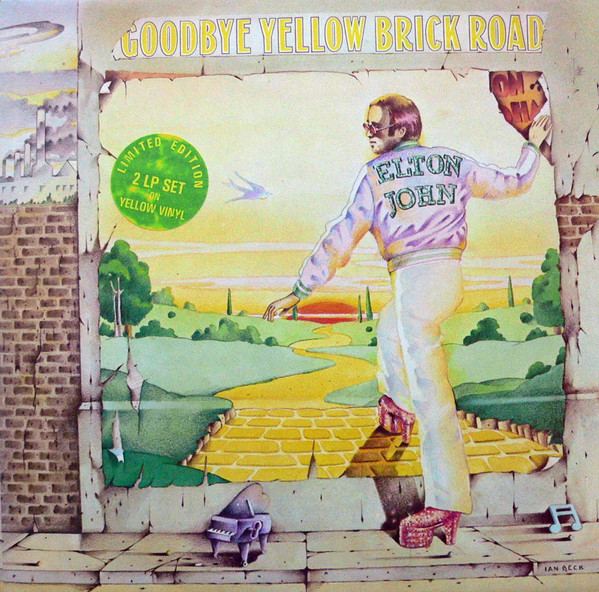
This copy: DJM Records DJE 29001 · 2LP · Limited-edition yellow vinyl reissue · Tri-fold sleeve · UK · 1978
Producer: Gus Dudgeon · Original release: October 1973
Introduction
By 1973, Elton John was the biggest pop star in the world, and the most prolific. In just three years he had released Elton John, Tumbleweed Connection, Madman Across the Water, Honky Château and Don’t Shoot Me I’m Only the Piano Player, and played around 100 concerts a year.
Goodbye Yellow Brick Road is the peak of that run. It’s a sprawling double album of 17 songs that covers nearly every style Elton could play: prog-rock epics, glam stompers, ballads, cinematic narratives, soul, reggae pastiche and rock ‘n’ roll. It reached No. 1 in both the UK and the US, spent eight weeks at the top in America, and has sold an estimated 30 million copies. Many fans and critics consider it his masterpiece.
My copy is a 1978 UK reissue on limited-edition yellow vinyl, a nice touch for an album with this title, and a collectable variant in its own right.
Track Listing
All music by Elton John, lyrics by Bernie Taupin, except where noted.
Side One
1. Funeral for a Friend / Love Lies Bleeding (11:09)
One of the great opening tracks in rock. “Funeral for a Friend” is a dramatic instrumental overture. Wind and a mournful synthesizer lead to a grand, churchy piano theme and a huge rock build. Elton reportedly wrote it imagining the music he’d like at his own funeral. It then crashes into “Love Lies Bleeding,” a hard-rocking breakup song with Davey Johnstone’s best guitar work. It’s Elton at his most prog.
2. Candle in the Wind
A tender tribute to Marilyn Monroe, written from the perspective of a young fan. It’s one of Taupin’s best lyrics and one of Elton’s best melodies. In 1997 they rewrote it for Princess Diana‘s funeral. That version became the best-selling single in UK chart history.
3. Bennie and the Jets
A strange, stomping, glam-soul song about a fictional futuristic rock band. The crowd noise and applause were added in the studio to make it sound live. It became an unexpected US No. 1 and crossed over to the R&B chart, which led to a famous appearance on Soul Train. Its staccato piano and falsetto “B-B-B-Bennie” are instantly recognizable.
Side Two
4. Goodbye Yellow Brick Road
The title track is one of Elton’s most beautiful songs. It’s about giving up the glamorous city life and returning to simple roots. The lyric takes its central image from The Wizard of Oz. It reached US No. 2 and UK No. 6.
5. This Song Has No Title
A short, gentle, philosophical piece with Elton playing much of it himself on keyboards.
6. Grey Seal
A re-recording of a song first released as a B-side in 1970. This version is a rousing, piano-driven rocker with surreal, mysterious lyrics.
7. Jamaica Jerk-Off
A playful reggae pastiche, credited jokingly to “Reggae Dwight” (Elton’s real surname is Dwight) and “Toots Taupin.” It’s a nod to the album’s aborted Jamaica sessions and an affectionate joke rather than a serious attempt at reggae.
8. I’ve Seen That Movie Too
A slow, cinematic ballad about a cheating lover, with lush orchestration by Del Newman. It’s one of the album’s underrated gems.
Side Three
9. Sweet Painted Lady
A gentle song about a sex worker, sung in a music-hall style with a waltz rhythm and sound effects.
10. The Ballad of Danny Bailey (1909–34)
A cinematic, orchestral story about a Depression-era gangster gunned down by the police, in the style of John Dillinger. It shows Taupin’s love of Americana and old movies.
11. Dirty Little Girl
A heavy, nasty rocker with a mean riff. It’s one of the album’s weaker lyrics.
12. All the Girls Love Alice
A dark, propulsive rock song about a young lesbian woman who dies tragically. It was a bold subject for a 1973 pop record, and it became a live favourite with a powerful guitar workout.
Side Four
13. Your Sister Can’t Twist (But She Can Rock ‘n Roll)
A short, joyful pastiche of early-1960s rock ‘n’ roll, with Farfisa-style organ and a doo-wop feel.
14. Saturday Night’s Alright for Fighting
Elton’s hardest-rocking single, with a crunching Davey Johnstone riff and a lyric about rowdy Saturday nights in Taupin’s Lincolnshire youth. It was the album’s first single, released before the album, and reached UK No. 7 and US No. 12.
15. Roy Rogers
A wistful, gentle song about escaping into the cowboy films of the singing star Roy Rogers.
16. Social Disease
A playful, bluesy country-rock song about a drunk, with banjo and saxophone. The sax is played by Leroy Gomez, who later fronted Santa Esmeralda.
17. Harmony
A lovely, harmony-rich closer about the joy of music. It was popular on radio and is a fan favourite.
Recording and Enthusiast Details
The Jamaica disaster
- Elton and the band originally planned to record in Kingston, Jamaica, at Dynamic Sound Studios, where the Rolling Stones had made Goats Head Soup. The sessions coincided with the Foreman–Frazier heavyweight title fight in Kingston in January 1973, and the city was tense and chaotic.
- Problems piled up: poor equipment, a bad piano, security issues and tense labour disputes at the studio. The band gave up and left. Taupin had written most of the lyrics in their hotel, and Elton reportedly wrote much of the music there too, in about three days.
The Honky Château
- The album was recorded instead at the Château d’Hérouville, a residential studio in a French country house near Paris, in May 1973. Elton had already recorded Honky Château and Don’t Shoot Me there. David Bowie, T. Rex and Pink Floyd also worked at the Château.
- The band reportedly recorded the whole album in about 18 days.
People
- Producer: Gus Dudgeon, who produced all of Elton’s classic early albums as well as David Bowie’s “Space Oddity.”
- Engineer: David Hentschel. He’s also credited with the ARP synthesizer that opens “Funeral for a Friend,” and went on to produce Genesis.
- Orchestral arrangements: Del Newman.
- The Elton John Band:
- Davey Johnstone: guitars, banjo, backing vocals
- Dee Murray: bass, backing vocals
- Nigel Olsson: drums, backing vocals
- Murray and Olsson’s high harmonies, combined with Johnstone’s guitar, were central to Elton’s 1970s sound.
The cover
The famous illustration of Elton stepping into a poster of the yellow brick road is by Ian Beck. The tri-fold sleeve, with an extra panel, displays illustrations for each song alongside the lyrics.
About My Pressing: 1978 Yellow Vinyl Reissue
- What it is: a limited-edition UK reissue on yellow vinyl, using the original DJM catalogue number DJE 29001. Coloured-vinyl editions of classic albums were a popular collector’s marketing tactic in the late 1970s, when coloured vinyl was a novelty.
- Dating: sources disagree. Discogs lists this pressing as October 1978, but other dealer listings use the same catalogue number for the original 1973 issue.
- Sleeve: my copy has the tri-fold sleeve. Dealers note that the tri-fold was used on first issues, while later pressings switched to a standard gatefold. A contributor on 45worlds describes yellow copies with a tri-fold sleeve printed by Robor Limited.
- Labels: yellow-vinyl copies typically have yellow labels.
- Hype sticker: some copies came with a yellow-and-green promotional sticker, which adds value if it’s present. Mine does not have it 🙁
- Sound: coloured vinyl from the 1970s was often slightly noisier than black, but a clean copy should still sound good. The original DJM cutting is generally well regarded. Listen for noise in the quiet passages, such as the opening of “Funeral for a Friend,” the title track and “Harmony.”
- Value: depending on condition, yellow copies sell at a premium compared with standard black pressings. The sticker, a clean tri-fold sleeve and the original inner sleeves all add to the value.
Final Thoughts
Goodbye Yellow Brick Road is Elton John at the height of his powers: ambitious, versatile and endlessly melodic. Its best songs are among the greatest pop recordings of the 1970s: “Funeral for a Friend / Love Lies Bleeding,” “Candle in the Wind,” “Bennie and the Jets,” the title track and “Saturday Night’s Alright for Fighting.” The deep cuts, like “I’ve Seen That Movie Too,” “All the Girls Love Alice” and “Harmony,” are almost as good.
As with most double albums, there’s some filler. “Jamaica Jerk-Off,” “Dirty Little Girl” and “Social Disease” could go without much loss. But even the lesser songs have charm, and the album’s variety is part of its appeal.
Highlights: “Funeral for a Friend / Love Lies Bleeding,” “Candle in the Wind,” “Goodbye Yellow Brick Road,” “Bennie and the Jets,” “Saturday Night’s Alright for Fighting.”
Weakest moments: “Jamaica Jerk-Off,” “Dirty Little Girl.”