 Vinyl Review
Orbital — Orbital (“The Green Album”) (1991)
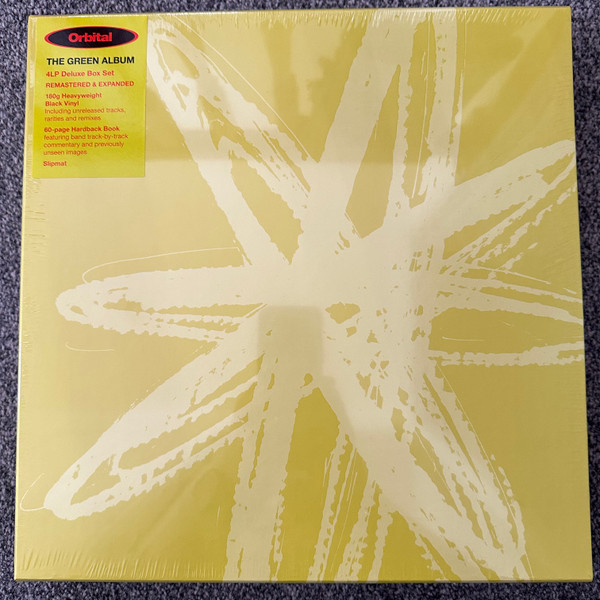
This copy: London Records LMS1725118 / LMS1725120 · Deluxe expanded 4LP box set: two 180g gatefold 2LPs, the original album plus a 2LP of rarities and remixes · Remastered · Europe · Released 19 April 2024
Original release: September 1991, ffrr / London Records
Introduction
Orbital are brothers Paul and Phil Hartnoll from Sevenoaks, Kent. They named themselves after the M25 London Orbital motorway, the road thousands of ravers drove around in the late 1980s, searching for illegal parties in fields and warehouses on the edge of the capital.
Their first single, “Chime,” was famously recorded at home on a modest setup, reportedly in their dad’s house and onto cassette. It was released in 1989 and became a UK Top 20 hit in 1990, and the brothers appeared on Top of the Popslooking like a pair of lads from the suburbs. It’s now one of the foundational records of British electronic music.
Their untitled 1991 debut album became known as “The Green Album” because of its cover, which tells it apart from their 1993 second album, also untitled and known as “The Brown Album.” It’s a collection of hypnotic, melodic, emotional techno that showed electronic dance music could work as a home-listening album as well as in clubs. It paved the way for Orbital’s legendary Glastonbury performances, the classic In Sides (1996) and decades of influence.
This 2024 deluxe box was released ahead of their Green and Brown album tour.
The Album (LPs 1 and 2)
The tracks below are from the original album. The 2024 edition adds live versions and extra tracks, so check the order on your labels.
The Moebius
A shimmering, gradually building opener named after the Möbius strip. It’s a perfect introduction to the Orbital sound of repetition, layering and melody.
Speed Freak
A fast, acid-tinged track with a restless, driving pulse.
Oolaa
A playful, bouncy track with a strong rhythmic groove.
Desert Storm
Named after the 1991 Gulf War operation. It’s a darker, tense track that reflects the mood of the time.
Fahrenheit 3D3
A nod to the Roland TB-303, the bass synthesizer at the heart of acid house. It’s a squelching, hypnotic acid track. (The title also nods to Ray Bradbury’s Fahrenheit 451.)
Steel Cube Idolatry
A hard, mechanical, industrial-edged techno track.
High Rise
A darker, atmospheric track with a sense of urban isolation.
Chime (live)
The album includes a live version of their debut single rather than the studio original. Its bright, pealing melody and rising build are pure early-rave euphoria.
Midnight (live)
Another early single in a live version. It’s darker and more hypnotic.
Belfast
One of the most beautiful pieces of 1990s electronic music, named after a gig the brothers played in the city. It’s built on a sampled choral voice and a slow, uplifting progression that captures the emotional, communal side of rave culture. It’s often their emotional high point in concert.
I Think It’s Disgusting
A short, odd, sample-based closer.
The Bonus Records (LPs 3 and 4)
The second 2LP collects rarities from the same era, including:
- “Satan”: one of their most famous early tracks. Its heavy guitar sample is reportedly from the Butthole Surfers. A live version from the 1990s reached the UK Top 3.
- “L.C.1,” “Torpedo Town” and “Crime”: B-sides and EP tracks from the early singles.
- “Open Mind Jam”: described in the release’s track listing as previously unreleased.
- Further remixes and versions from the period.
Check the exact track list on your sleeve. The 4CD edition has even more, with 42 tracks, including more 12″ versions and the unreleased “The Other One.”
What’s in the box
- A 60-page hardback book about the band’s story and history.
- A 12″ slipmat.
- Some retailers mention three printed A6 flyers tucked randomly into the book. (mine copy came with two of these flyers)
Enthusiast Details
- Equipment: early Orbital was built on affordable gear of the day, such as the Roland TB-303, TR-808 and TR-909 drum machines and early samplers and synths. The Hartnolls became famous for performing live, building tracks on stage from sequencers and synths rather than DJing pre-recorded tracks. That was rare for dance acts in the early 1990s, and it made them a festival favourite.
- Glastonbury: their 1994 headline set on the NME Stage at Glastonbury is often credited with making dance music a mainstream part of rock festivals. They became a Glastonbury institution.
- Their trademark: the brothers’ head-mounted torch glasses, lights fitted to spectacles, are one of electronic music’s most recognisable images.
- Splits and reunions: they split in 2004, reformed in 2008, split again in 2014 and reformed in 2017. Paul and Phil remain Orbital today.
- Influence: Orbital helped define “intelligent techno” and electronic albums made for home listening. The approach influenced the Chemical Brothers, Leftfield, Underworld and others.
Final Thoughts
Orbital is a landmark: the debut album by one of Britain’s most important electronic acts, made just as rave was turning into something more lasting. It’s hypnotic, melodic and emotional, and tracks like “Belfast,” “Chime” and “The Moebius” still sound wonderful more than thirty years later.
As an album, it’s a little uneven. It was assembled partly from singles and live versions, and some of the shorter tracks, like “I Think It’s Disgusting,” feel like filler. The Brown Album and In Sides are more complete statements.
The deluxe box adds real value, especially “Satan” and the early B-sides, which were previously hard to find on vinyl. Two 180g gatefold 2LPs, a hardback book and a slipmat make it a lovely package.
Highlights: “Belfast,” “Chime,” “The Moebius,” and “Satan” from the bonus discs.
Weakest moment: “I Think It’s Disgusting.”